

DEAR FRIENDS OF JUST CITY
Behind every form and every file is a human being.
Here at Just City, we know that fairness shouldn't depend on how much money you have. Still, every year we face new legislation on the local, state, and federal levels that reduce people to their worst moments and keep them trapped in a broken cycle. That's why we’re organizing our work around two core pillars: Tell the Truth and Fight the Fight.
We believe we must name systemic failures directly, whether it's the Shelby County Sheriff’s Office or a missing piece of paperwork, even when it is uncomfortable. That is how we Tell the Truth. We don't stop at pointing out the problem. We push, litigate, and advocate on behalf of people the system has failed. That is how we Fight the Fight.
Every day a person sits in jail due to a missed email is a day their life is on hold. Inside this update, you'll read exactly what happens when systems don't talk, and how our relentless advocacy is identifying these overlooked cases and ensuring people are not left behind.
This work highlights a frustrating reality: many cases only move when someone is paying attention. We hope you will do the same.
Onward, together,
Josh Spickler
Executive Director

A stable and properly functioning jail system is essential to public safety, public health, and the integrity of the justice system,”
– Shelby County Sheriff Floyd Bonner, Jr.
We agree with Sheriff Bonner.
That’s why Just City is dedicated to telling the truth about what’s really going on in the jail at 201 Poplar. The long and short of it is: the jail is neither stable nor properly functioning.
You’ve heard Just City speak out against the conditions at the jail. We’ve outlined the inadequate health care, the chronically broken HVAC system, and disgusting conditions. After another avoidable death last summer, we spent $50,000 from our bail fund as quickly as we could to free people from these deadly conditions.
But the dangers are not confined to the building. Many people are trapped in the jail longer than necessary because of paperwork. The staff responsible for ensuring people are transferred to long-term facilities are routinely failing to do their job.
The justice system depends on people doing their jobs. But what happens when they don’t?
Communities use jails differently. Shelby County uses its jail almost exclusively for people being held pretrial, which fits the definition of a jail offered by the Bureau of Justice Statistics: “a short-term facility, designed to hold people who have not yet been convicted of a crime, or are sentenced to an incarceration sentence of 1 year or less.” Jails are not built with the capacity or services for long-term incarceration. Prisons are designed for that purpose.
Despite this guidance, the troubling reality is that people remain in our jail for years. Some of them are there because of communication gaps among agencies or administrative delays after their case is completed.
What is a jail?
WHY IS PAPERWORK
SO IMPORTANT?
Communication is critical when freedom is at stake. Yet, the Shelby County Sheriff's Office (SCSO) frequently fails to provide critical information to the Tennessee Department of Correction (TDOC). At the end of a person’s case, after sentencing, the SCSO is responsible for sending judgment and sentencing paperwork to TDOC. Jail credits – the amount of time a person has spent in pretrial detention – are critical. However, this information is not always communicated.
Without sentencing paperwork, TDOC does not know to initiate a transfer—leaving people stranded in the dangerous, overcrowded jail.


What We Found
Human beings get lost in the system.
When the Sheriff's Office doesn't send sentencing paperwork or apply earned jail credits, TDOC has no idea that people exist and are ready for transfer.
They stay stuck in a dangerous, overcrowded jail.
When the Sheriff's Office doesn't send sentencing paperwork or apply earned jail credits, TDOC has no idea that people exist and are ready for transfer.
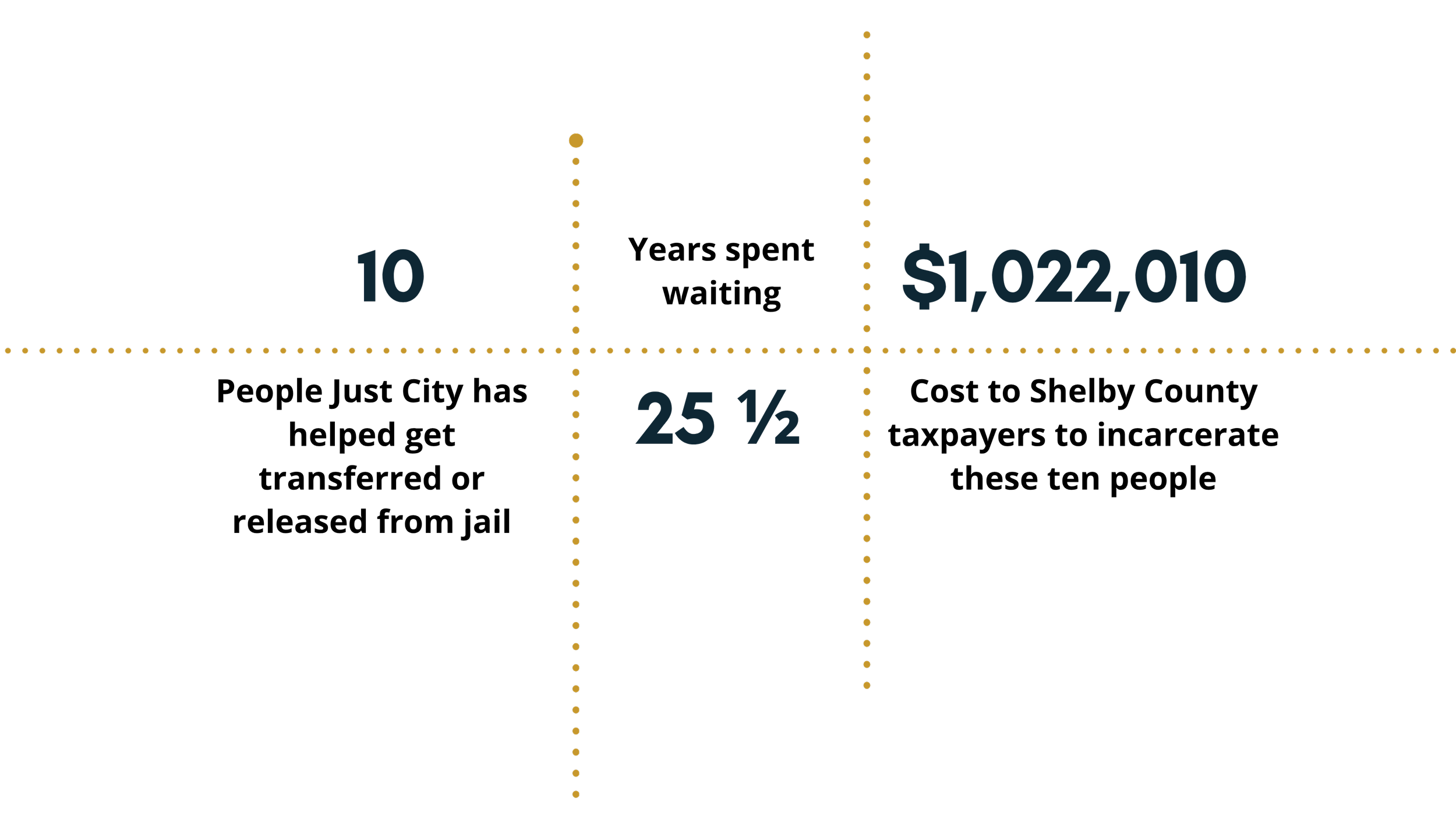
Just ten people in the Shelby County Jail collectively lost 25.5 years of their lives waiting, costing taxpayers an estimated $1,022,010 for unnecessary detention.
The cost is staggering.
What We’re doing about it
We work directly with the Sheriff's Office to gather and deliver the missing sentencing paperwork and jail credit records to TDOC, prompting the transfer of people who had been invisible to the system.
we bridge the gap
By making sure earned jail credits are properly applied, we help establish an official release date—sometimes moving that date forward significantly or granting immediate release for those who already served their full sentences.
we correct the math
we continue the work
We are finalizing paperwork for four more people who are expected to be released soon, having almost completed their entire sentences in the jail.
the need is vast
There are at least 100 more people in jail in the same position—sentenced but never transferred. They are still waiting.